Pakistani freelancers earned $1.76 billion in export income in FY2025-26, and the country now ranks among the top three or four freelance markets in the world. At the same time, millions of Pakistanis still depend on a traditional salary for stability. So which path fits you: freelancing or a job?
There’s no single right answer. It depends on your risk tolerance, your skills, and what stage of life you’re in. This guide breaks down the real numbers, the honest trade-offs, and a step-by-step way to decide.
Key Takeaways
- Pakistan’s freelancers earned $1.76 billion in FY2025-26, and average per-capita freelancer earnings rose from about $12/month in 2021 to nearly $53/month in 2026 (State Bank of Pakistan data).
- Freelancers registered with PSEB pay a reduced tax rate of just 0.25% on export income, well below salaried tax slabs.
- Freelancing wins on income ceiling and flexibility; a job wins on predictability and employer-paid benefits.
- A hybrid approach, keeping your job while freelancing part-time, is the lowest-risk way to test the waters.
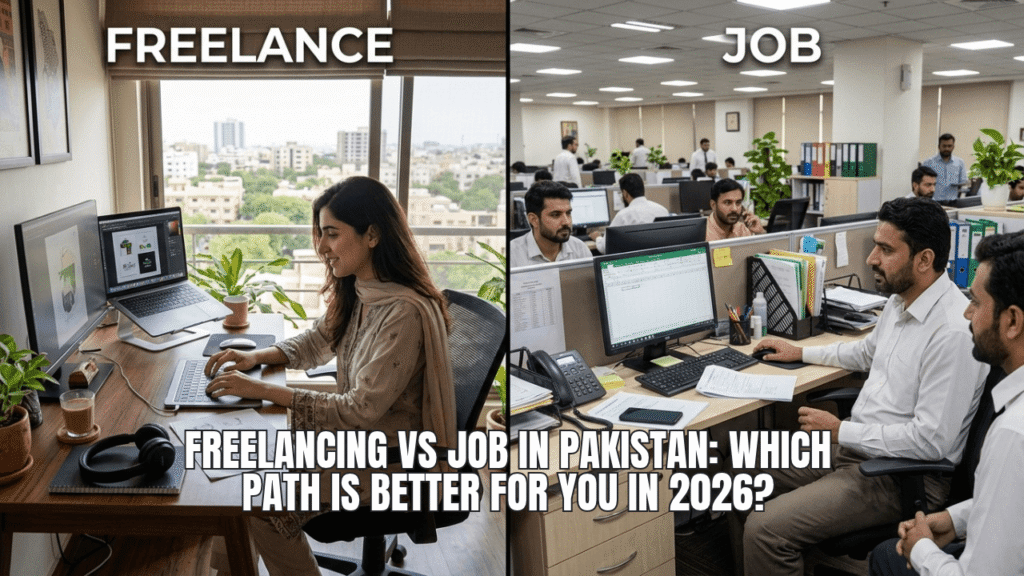
Pakistan’s Freelance Economy in 2026: The Real Numbers
Before comparing the two paths, it helps to know where Pakistan actually stands.
- Pakistani freelancers generated $1.76 billion in export earnings in FY2025-26, according to the country’s finance adviser.
- Pakistan is home to an estimated 2.37 to 3 million freelancers, per Asian Development Bank estimates.
- Average per-capita freelancer earnings rose from roughly $12/month in 2021 to nearly $53/month in 2026, a 4.4x jump in five years, based on SBP data.
- Pakistan ranks among the top three or four countries on major global freelancing platforms, and the Pakistan Economic Survey 2024-25 described it as the second-largest provider of digital labor globally.
- Freelancers registered with the Pakistan Software Export Board (PSEB) pay a reduced 0.25% tax on their export income, far below standard salaried tax slabs.
Pro Tip: Register with PSEB early if you plan to freelance seriously. The 0.25% rate and formal export status make it easier to open a business bank account and receive payments through legal channels like Payoneer or Wise.
What Is Freelancing?
Freelancing means working independently instead of for a single employer. You offer your skills to multiple clients, often across borders, and get paid per project or per hour. Common fields for Pakistani freelancers include:
- Web and app development
- Graphic design and video editing
- Content writing and copywriting
- Digital marketing and SEO
- Virtual assistance and data entry
- Online tutoring and consulting
You choose your projects, set your rates, and work from anywhere with a stable internet connection.
What Is a Traditional Job?
A traditional job means working for one employer in exchange for a fixed salary, benefits, and set hours. In Pakistan, this spans:
- Government positions
- Private corporate roles
- Banking and finance
- Education and healthcare
- Manufacturing and retail
Jobs trade some flexibility for predictable income and, often, social protections that freelancers have to arrange for themselves.
Freelancing vs Job: Key Differences
Income Potential
Freelancing: Your ceiling is set by your skills and client base, not a pay scale. Entry-level freelancers in Pakistan often start around PKR 20,000 to 50,000/month (roughly $72 to $180). Experienced freelancers serving international clients can reach PKR 150,000 to 400,000+/month ($540 to $1,440+). Income is inconsistent month to month, especially early on.
Job: Entry-level roles typically pay PKR 25,000 to 50,000/month. Mid-level roles range from PKR 75,000 to 150,000/month. Senior roles at multinationals can exceed PKR 200,000/month. The advantage is predictability: the same amount lands on the same date every month.
Work Flexibility
Freelancing: You control your schedule, your rates, and which projects you take on. This suits people balancing family commitments or who simply work better outside a 9-to-5 structure.
Job: Hours are usually fixed, often 9 AM to 5 PM. Leave requires approval, and remote work depends entirely on your employer’s policy.
Job Security
Freelancing: No guaranteed income. Clients can end contracts at any time, and a slowdown in their business becomes a slowdown in yours.
Job: Employment contracts, notice periods, and labor protections offer more stability. Most employers retain core staff even through rough economic patches.
Benefits and Perks
Freelancing: No employer-provided health insurance, retirement savings, or paid leave. You keep close to 100% of what you earn (minus platform fees and taxes), but you also fund your own safety net.
Job: Employers often provide health insurance, provident fund, gratuity, bonuses, and paid leave, benefits that add real value beyond the base salary.
Common Mistake: New freelancers often price their services as if they were still earning a salary, without accounting for the health insurance, retirement savings, and paid leave they no longer get for free. Build that cost into your rates.
Career Growth
Freelancing: Growth comes from reputation, expanding skills, and raising your rates. There’s no promotion ladder, your track record is your resume.
Job: Clear paths through promotions, raises, and title changes, often supported by structured training and mentorship.
Skill Development
Freelancing: You have to proactively learn to stay competitive. There’s no formal training budget unless you invest in it yourself.
Job: Many employers fund workshops, certifications, and structured learning as part of the role.
Advantages of Freelancing in Pakistan
- No income ceiling. You grow earnings by taking more projects, raising rates, or specializing in high-demand skills. Serving international clients also means earning in USD or GBP while spending in PKR.
- Location independence. Work from Lahore, Karachi, Islamabad, or a smaller city like Sialkot or Multan. All you need is reliable internet.
- Varied project experience. Multiple clients across industries build a broader, more resilient skill set than a single job usually allows.
- Lower tax burden. PSEB-registered freelancers pay just 0.25% on export income, and legitimate business expenses are deductible.
- A personal brand you own. Freelancing lets you build a reputation that follows you, not one tied to an employer’s name.
Advantages of Traditional Jobs in Pakistan
- Financial stability. A regular salary makes budgeting and loan approvals easier. Banks treat salaried applicants as lower risk.
- Built-in social security. Provident fund, gratuity, and group insurance give you a safety net you don’t have to build yourself.
- A professional network. Colleagues and mentors inside an organization can open doors throughout your career.
- Structure. Clear roles and reporting lines reduce ambiguity, which lowers stress for a lot of people.
- Credibility. A recognizable employer on your resume makes future job hunting easier.
Challenges of Freelancing in Pakistan
- Payment friction. PayPal isn’t available in Pakistan, so freelancers rely on Payoneer, Wise, or direct bank transfers, each with its own fees and delays.
- Client acquisition. Consistent work depends on marketing, proposals, and negotiation, skills many talented freelancers never formally learn.
- Isolation. Working alone, without office interaction, can wear on motivation over time.
- No paid time off. A day off is a day of unpaid income unless you plan around it.
- Admin overhead. Invoicing, taxes, and client management all fall on you.
Challenges of Traditional Jobs in Pakistan
- Slower growth. Promotions follow organizational timelines that can feel slow for high performers.
- Office politics. Navigating hierarchy and workplace dynamics takes energy that has nothing to do with the actual job.
- Commute time. Daily travel in Karachi or Lahore traffic eats hours you won’t get back.
- Skill stagnation. Employers that don’t invest in training can leave your skills outdated over time.
- Work-life imbalance. Long hours and thin leave policies can strain health and relationships.
Who Should Choose Freelancing?
Freelancing tends to suit people who:
- Are self-motivated and comfortable managing their own schedule
- Already have in-demand digital skills
- Value flexibility over guaranteed income
- Can handle a few lean months without panicking
- Communicate well enough to manage international clients
Who Should Choose a Traditional Job?
A job tends to suit people who:
- Want predictable income and routine
- Value being around colleagues day to day
- Need employer-provided health insurance or retirement savings
- Are early-career and want structured mentorship
- Plan to apply for loans or a mortgage soon, where salary slips matter
The Hybrid Approach: Best of Both Worlds
A growing number of Pakistanis don’t choose one path outright. Instead, they:
- Keep a full-time job and freelance part-time on evenings or weekends
- Build a client base gradually before making freelancing full-time
- Maintain a mix of retainer clients and project work
- Use freelance income to build an emergency fund before quitting the job
Pro Tip: Before quitting your job, aim to replace at least 70 to 80% of your salary with consistent freelance income for three straight months. That buffer makes the transition far less stressful.
Skills That Matter Either Way
Regardless of the path you pick, these skills carry weight in Pakistan’s job market right now:
- Technical skills specific to your field, whether that’s coding, design, writing, or analysis
- Communication, especially clear written English for client or workplace interactions
- Time management, since deadlines exist whether they’re self-imposed or employer-set
- Continuous learning, to keep pace with new tools and industry shifts
- Financial literacy, for managing income, taxes, and savings on either path
How to Decide: Practical Steps
- Assess your situation. Look at your financial obligations, risk tolerance, and existing savings.
- Test before you commit. Take on small freelance projects while still employed to gauge real demand for your skills.
- Run the numbers. Compare your current or potential salary against realistic freelance income, after platform fees, taxes, and the cost of benefits you’d lose.
- Build a buffer. Keep 3 to 6 months of expenses saved before making any full switch.
- Learn from people who’ve done it. Pakistani freelancing communities on Facebook and LinkedIn are full of people who’ve made this exact decision.
Frequently Asked Questions
Which is better: freelancing or a job in Pakistan?
It depends on your priorities. Freelancing offers higher income potential and flexibility but less stability. A traditional job offers security and benefits but a slower, capped growth curve. Weigh your risk tolerance and current financial obligations before deciding.
How much can freelancers actually earn in Pakistan?
It varies widely by skill and experience. Beginners often earn PKR 20,000 to 50,000/month. Freelancers with a couple of years of experience serving international clients can reach PKR 150,000 to 400,000+/month. Nationally, average per-capita freelancer earnings were close to $53/month in 2026, according to SBP data, though this figure includes part-time and beginner freelancers alongside top earners.
Frequently Asked Questions
It depends on your priorities. Freelancing offers higher income potential and flexibility but less stability. A traditional job offers security and benefits but a slower, capped growth curve. Weigh your risk tolerance and current financial obligations before deciding.
It varies widely by skill and experience. Beginners often earn PKR 20,000 to 50,000/month. Freelancers with a couple of years of experience serving international clients can reach PKR 150,000 to 400,000+/month. Nationally, average per-capita freelancer earnings were close to $53/month in 2026, according to SBP data, though this figure includes part-time and beginner freelancers alongside top earners.
Yes. Freelancers should register with the FBR and file returns. Those registered with PSEB pay a reduced 0.25% tax on export income. A tax advisor can help you structure this correctly.
Yes, and many people do. Check your employment contract for any restriction on outside work, and make sure your freelance work doesn’t compete directly with your employer.
Upwork, Fiverr, Freelancer.com, and Toptal are the most used international platforms. Rozee.pk is a good option for local freelance work. Fees and client pools differ, so it’s common to register on more than one.
Payoneer, Wise, and direct bank transfers are the standard options. PayPal isn’t available in Pakistan, so most freelancers build their payment setup around one of these three.
Government jobs generally offer stronger long-term security. Private sector roles tend to offer higher pay and faster growth, with somewhat less security.
Conclusion
There’s no universal winner in the freelancing vs job debate in Pakistan. Your best choice depends on your skills, your financial cushion, and how much uncertainty you can handle.
Choose freelancing if you value freedom, already have marketable skills, and can manage inconsistent income. Choose a job if you need stability, structured growth, or employer-provided benefits. Or, if you want to hedge your bets, start with the hybrid approach and let real results guide your next move.
This isn’t a permanent decision. Plenty of people in Pakistan have moved between freelancing and employment more than once. What matters is making the call that fits where you are right now.