Two years ago, dropshipping from Pakistan meant hours of manual grind. Thinking or by guessing, you can’t find any winning product by scrolling AliExpress. You wrote your own product descriptions, and they weren’t great. You hired a designer for ad creatives and waited days for a reply. Hoped, that something would sell.
That version of dropshipping is fading out. In 2026, Sellers running profitable stores. With the help of A. They handles product research, copywriting, customer support, and ad creatives. Spending very less time and get maximum results. You’re the operator; the AI is your unpaid team.
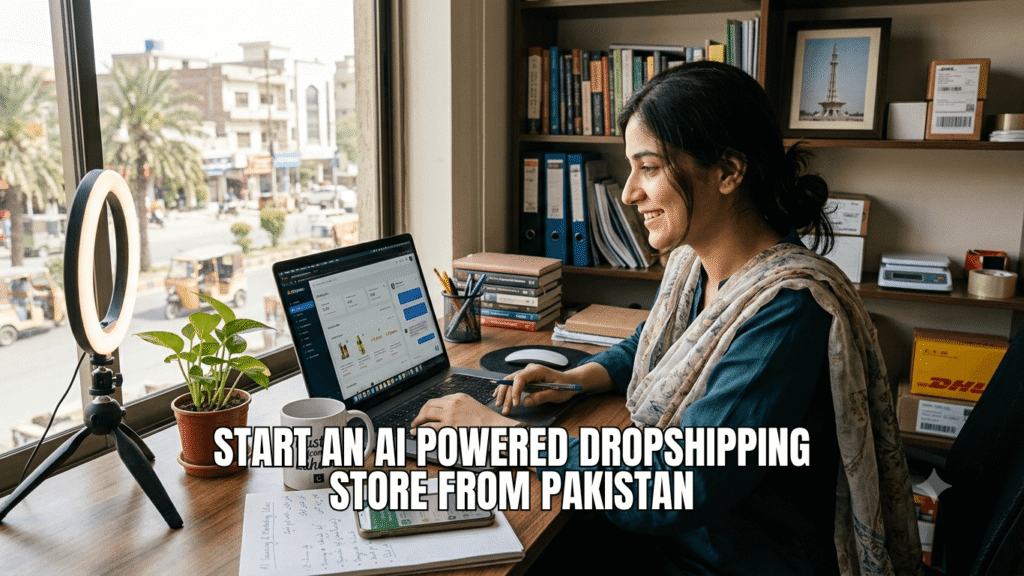
This guide walks through how someone based in Pakistan can set up an AI-assisted dropshipping store and sell to customers in the US, UK, Canada, or the Gulf, without a design degree or a marketing background.
Key Takeaways
- AI tools now handle product research, copywriting, ad creatives, and customer support, so a solo operator in Pakistan can run a store that used to need a small team.
- Earning in USD/GBP while paying costs in PKR is the real structural advantage for Pakistani sellers, not the AI itself.
- Budget for a genuine testing phase (roughly $150–$300 / PKR 41,700–83,400 in ad spend) before expecting any profit. There’s no guaranteed outcome, and most first attempts lose money before they find a winning product.
- Payoneer and Wise are the practical rails for getting paid from Pakistan; Stripe still isn’t directly available here.
- Skipping AI customer support and legal pages (refund policy, privacy policy) is the fastest way to tank trust with both customers and ad platforms.
Is Dropshipping Still Worth It in 2026?
Dropshipping isn’t dead. Lazy dropshipping is dead.
Selling whatever’s trending on TikTok, with a copy-pasted description and a hope that Facebook ads carry the rest, is what killed most stores over the past few years. What still works: picking a specific niche, building a store that looks legitimate, and using AI to move faster than sellers still doing everything by hand.
The advantage for someone in Pakistan is straightforward. Your costs sit in PKR. If you’re targeting Western customers, your revenue comes in USD or GBP. That exchange rate alone makes even a modest store worth running seriously.
The AI Tools You Actually Need
You don’t need ten subscriptions. Here’s the real stack people are using right now.
| Tool | What It Does |
|---|---|
| ChatGPT or Claude | Product descriptions, ad copy, email sequences |
| Canva AI (Magic Design) | Product images, ad creatives, store banners |
| CapCut AI | AI-generated UGC-style video ads for TikTok |
| AutoDS or Zendrop | Trending product research, order fulfillment automation |
| Tidio or Gorgias | AI chatbot for store customer support |
| Perplexity | Competitor and market research |
Step 1: Pick a Niche With Data, Not a Gut Feeling
Stop scrolling TikTok for “trending products” and copying whatever shows up. Use AI for direction, then confirm with data.
Ask ChatGPT or Claude something specific, like: “List 15 physical product niches with rising search interest in the US and Canada, low competition on Shopify, sourceable from AliExpress or CJdropshipping.”
Cross-check the suggestions in Google Trends and the AliExpress Dropshipping Center, which shows order volume for similar products. AI gives you a starting list; the data tells you which ideas are actually worth testing.
Go narrow. “Pet grooming tools for anxious dogs” beats “pet products.” Specific niches convert better and cost less to advertise, since your ad copy can speak directly to one problem instead of a vague category.
Step 2: Build Your Store Without Hiring a Designer
Shopify remains the standard, and Shopify’s built-in AI features make setup faster than it used to be.
Use Canva’s AI tools to design your logo, product mockups, and homepage banners in under an hour. Shopify Magic generates product descriptions directly in your admin panel from a title and a few keywords.
For descriptions you actually want to keep, try this prompt with ChatGPT or Claude: “Write a product description for [product name] targeting [audience], focused on the main problem it solves, in a friendly and confident tone, under 150 words, with three bullet-point benefits.”
Don’t publish the first draft. Read it out loud once. If it sounds like a robot wrote it, ask the AI to rewrite it “more casually, like a friend recommending it.”
Step 3: Set Up AI Customer Support From Day One
This is the part most Pakistani dropshippers skip, and it’s usually why bad reviews pile up.
Tools like Tidio ship with an AI chatbot that can answer “where’s my order,” “what’s your return policy,” and “does this fit size medium” around the clock. Your customers are almost always in a different time zone from you. An always-on chatbot protects your store’s reputation while you sleep.
Set it up once with your FAQ, shipping times, and return policy, and it handles the rest.
Step 4: Use AI for Ad Creatives, Not Just Product Photos
Paid ads are the most reliable way for new dropshippers to get first sales. The creative decides whether an ad works, not the targeting settings.
CapCut’s AI tools generate UGC-style video ads using AI avatars or stock footage, add auto captions, and match trending audio, without you filming anything. Pair this with a short AI-written script (ChatGPT or Claude) that follows a simple hook → problem → solution → call-to-action structure.
Run these on TikTok Ads or Meta Ads with a small daily budget, roughly $5–$10 (PKR 1,400–2,800), and let the platform’s algorithm find buyers. Kill anything that isn’t getting engagement within 48 hours.
Niches Worth Testing Right Now
| Niche | Why It Works |
|---|---|
| Pet health and anxiety products | Emotional buyers, low return rates |
| Home organization for small spaces | Rising interest among apartment renters in the West |
| Desk and ergonomic accessories | Remote-work demand hasn’t slowed down |
| Skincare tools (not skincare products) | Sidesteps strict ad policies around cosmetic claims |
| Car interior accessories | Repeat buyers, easy to bundle |
Avoid anything needing FDA-style approval, medical claims, or electronics with battery shipping restrictions. These trigger ad account bans fast, and rebuilding trust with Meta or TikTok afterward can take weeks.
A Realistic Timeline, Not a Highlight Reel
Nobody makes real money in month one. Below is a rough, illustrative timeline based on common patterns reported by dropshipping operators, not a guarantee of results. Your outcome depends on niche, ad spend, execution, and market conditions.
| Phase | Timeframe | What’s Happening | Typical Range (illustrative only) |
|---|---|---|---|
| Setup | Week 1–2 | Store setup, product research | PKR 0 (investment phase) |
| First ads | Week 3–4 | Testing 2–3 products | Often a loss — this is normal |
| First traction | Month 2 | First profitable product found | Highly variable; no guaranteed figure |
| Scaling | Month 3–4 | Scaling the winning product | Highly variable; no guaranteed figure |
| Second line | Month 5–6 | Adding a second product | Highly variable; no guaranteed figure |
Treat any specific dollar projection you see online, including in this guide’s earlier drafts, with skepticism unless it comes with a source. Plan for consistent daily work and a genuine testing budget of roughly $150–$300 (PKR 41,700–83,400) in ad spend before expecting a clear signal on whether a product works.
Getting Paid and Managing Money From Pakistan
This trips up a lot of first-time sellers, so get it sorted before you launch.
- Payoneer: Connects with Shopify Payments in supported regions and works for receiving PayPal transfers indirectly through a linked account.
- Wise: Useful for holding USD and GBP balances and paying for tools like Shopify, CapCut Pro, or ad accounts without extra conversion losses.
- Stripe: Not available to individuals in Pakistan directly. Some sellers work through a partner abroad or a supported program; research the specific route carefully before committing.
- JazzCash or Easypaisa: Fine for local expenses, like paying for a VPS or a Fiverr freelancer helping with design.
Keep ad spend and product costs in a separate Wise account from day one. Mixing personal and business money makes it genuinely hard to tell whether the store is profitable.
Common Mistakes to Avoid
- Copying a store exactly. AI makes it easy to clone someone else’s store structure and descriptions in minutes. Buyers spot duplicate, generic listings fast. Use AI to make your version better, not identical.
- Skipping the chatbot setup. Stores without instant support lose sales nobody tracks. Buyers expect answers in seconds, not a two-day email delay.
- Testing too many products at once. Pick two or three, give each a real ad budget, and let the data decide. Spreading $5 across ten products tells you nothing useful.
- Skipping the legal basics. Add a refund policy, privacy policy, and terms of service page. AI can draft a first pass in minutes, but a store without these looks unprofessional and can get flagged by ad platforms.
Quick-Start Checklist
- Pick a niche using AI research plus Google Trends validation, not a guess
- Set up a Shopify store and generate first-draft product descriptions
- Design store banners and logo with Canva AI
- Install an AI chatbot (Tidio or similar) and load your FAQ
- Create three video ad creatives with CapCut AI
- Open a Wise account to separate ad spend from personal funds
- Set aside a $150–$300 testing budget before launch
- Limit the first test to two or three products
FAQ
It can be, but it isn’t passive income. Costs in PKR against revenue in USD/GBP is a genuine structural advantage, but success still depends on niche choice, ad execution, and a real testing budget.
Not directly as an individual. Payoneer and Wise are the more practical options for receiving international payments and holding foreign currency.
Plan for roughly $150–$300 (PKR 41,700–83,400) in testing spend. Treat any specific profit figure you see quoted online as unverified unless it’s sourced.
No. AI tools now cover store design (Canva), product descriptions (ChatGPT/Claude), and video ads (CapCut), which is the main shift from how dropshipping worked a few years ago.
AI won’t build a profitable store by itself. What it removes is the excuses that used to stop people from starting: the missing design skills, the writer’s block, the round-the-clock support problem. After that, it comes down to testing, patience, and sticking with a product long enough to see whether it clicks.