Estimated reading time: 7 minutes
Every shopkeeper in Pakistan is on WhatsApp. Almost none of them have a bot answering it. That gap is your opportunity.
Why This Is a Real Opportunity Right Now
Pakistani customers do not email businesses. They do not call. They message on WhatsApp and expect a fast reply.
Pakistan has over 50 million active WhatsApp users, and globally, 90% of WhatsApp messages get read within 3 minutes of being sent. That speed expectation applies whether a human or a bot is on the other end.
Most small businesses here reply manually. If at all. A clinic cannot keep up with 50 messages during peak hours. A restaurant loses every order that comes in after closing time because nobody is watching the phone. These businesses know they have a problem. They do not know an affordable solution exists.
You do not need to be a developer to fix this for them. You need a no-code bot builder, a WhatsApp Business connection, and a clear pitch.
Pro Tip: Do not lead with “I build AI chatbots.” Lead with the problem: “I can stop you from losing after-hours orders.” Business owners buy outcomes, not technology.
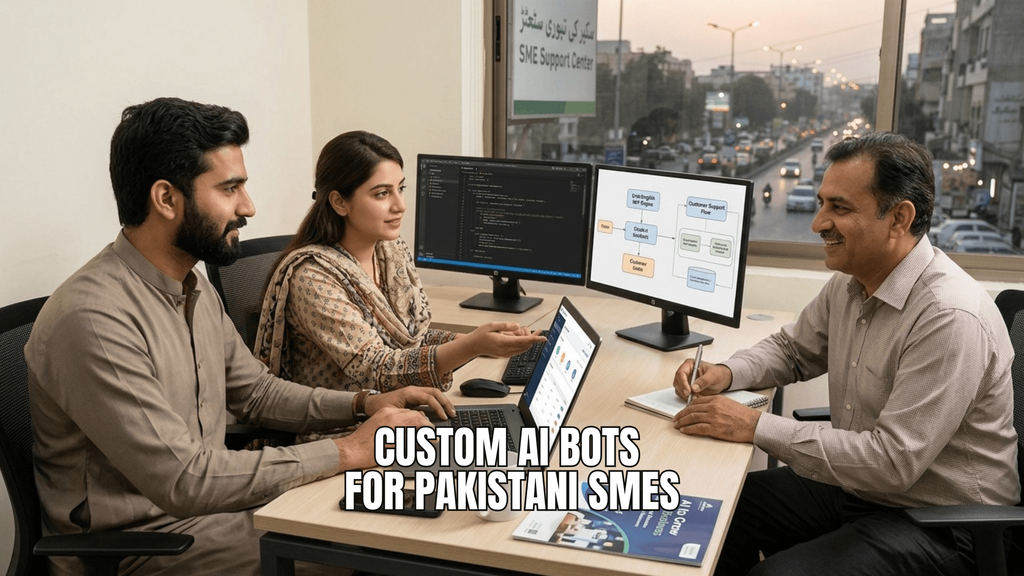
What You Need to Get Started
- A no-code bot builder. Botpress is a solid starting point. It connects directly to Meta’s WhatsApp Business API and supports LLM integration without writing code.
- An AI model for the bot’s brain. Claude or ChatGPT can power the responses. By feeding your bot your client’s exact FAQs, pricing, and policies, it delivers accurate, context-aware answers instead of guessing.
- A WhatsApp Business API connection. This is how the bot sends and receives messages on your client’s number.
- A simple flow map. Identify the business’s five most frequent customer questions before using any tools. That becomes your bot’s first version.
You do not need machine learning knowledge. You need to understand what a specific business needs answered, and how to translate that into a flow.
Step-by-Step: Building Your First Bot
1. Pick a niche, not a random client. Restaurants, clinics, salons, and small online stores are the easiest first targets. Their questions repeat: pricing, hours, location, availability, order status. Repetition is what makes a bot valuable.
2. Map the core conversation. Start with four intents: greeting, pricing, business hours or location, and human handoff. Do not try to automate everything on day one. A bot that handles four things well beats one that fumbles twenty.
3. Build the flow in Botpress. Connect it to WhatsApp through Meta’s official API. Set up the conversation nodes for each intent you mapped.
4. Feed it real business content. Give the AI model the client’s actual FAQs, price list, and common complaints. This is where Claude or ChatGPT does the heavy lifting, turning raw business information into natural replies instead of robotic scripts.
5. Set an escalation rule. Anything the bot is not confident about should route to a human. Complaints, refunds, and anything involving money should never be left fully automated.
6. Test it like a real customer. Message it in Urdu, Roman Urdu, and English. Pakistani customers switch between all three mid-conversation. If your bot only understands clean English than it will fail in the field.
Common Mistake: Don’t make the bot sound like a fancy robot. Pakistani customers prefer a natural tone that matches how the business actually speaks. If the shop owner is casual, the bot should be too.
What to Charge
Local agencies building WhatsApp chatbots for Pakistani businesses typically charge PKR 25,000 to PKR 60,000 for a standard setup, plus PKR 5,000 to PKR 12,000 a month for maintenance. Here’s how to break that into packages:
| Package | What’s Included | Price (PKR) | Price (USD, ~278/1) |
|---|---|---|---|
| Starter | Single WhatsApp number, up to 4 conversation flows, FAQ automation | 25,000 – 35,000 | $90 – $126 |
| Standard | 6-8 flows, order status or booking automation, human handoff | 40,000 – 60,000 | $144 – $216 |
| Monthly maintenance | Flow updates, monitoring, minor fixes | 5,000 – 12,000/mo | $18 – $43/mo |
Start at the lower end for your first two or three clients. You are building case studies, not maximising income yet. Once you have results to show, raise your rate.
Pro Tip: Always quote the monthly maintenance fee separately, even if the client does not take it immediately. It sets the expectation that a bot is not a one-time purchase, and it becomes your recurring income once they see the value.
How to Find Your First Client
You do not need Fiverr or Upwork for this. Your first client is probably five minutes from your house.
- Walk into local businesses that clearly struggle with WhatsApp response time. A restaurant with delayed replies. A clinic with a busy front desk. A boutique running Instagram ads but not replying properly.
- Offer a free working demo before asking for payment. Build a stripped-down version using their actual business info and show them live on WhatsApp. This converts far better than a pitch deck.
- Ask happy clients for one referral. In Pakistan, business owners trust word of mouth over cold outreach almost every time.
Common Mistake: Pitching the technology instead of the result. Do not say “I use Claude and Botpress to build LLM-powered conversational agents.” Say “Your customers get an instant reply, even at midnight, without you hiring anyone.”
Where This Can Go
Once you have a handful of local clients, you have two directions to scale:
- Stay local and go deeper. Add order automation, abandoned cart recovery for online sellers, and appointment booking for clinics and salons. Recurring maintenance fees add up fast across even 8-10 small clients.
- Take the same skill global. The exact same bot-building ability sells on Fiverr and Upwork in USD, where custom chatbot gigs range from around $90 for a basic build to $3,800+ for LLM fine-tuning work. Pakistani freelancers who pair AI tools with a specific service niche are already commanding two to three times higher rates than generalists offering the same service manually.
Either way, the skill is the same. The only thing that changes is who you are selling it to.
FAQs
No. Tools like Botpress are no-code, and you can use Claude or ChatGPT to generate the conversation content. Your job is mapping the business logic, not writing software.
The platform tools like Botpress can be free to start, but WhatsApp message charges apply separately through Meta’s approved provider channels. Factor this into your client pricing or have them cover it directly.
This is why escalation rules matter. Establish a confidence threshold to automatically route uncertain queries to a human agent rather than risking an incorrect guess. Never let the bot handle refunds, complaints, or anything involving money without a human check.
Restaurants, clinics, salons, and small online stores. They have repetitive, predictable questions and lose real money every time a message goes unanswered.
Yes. Bot builds are project-based, and maintenance is largely monitoring and small updates. A handful of clients on maintenance retainers can generate steady monthly income without full-time hours.
Key Takeaways
- Pakistani businesses lack WhatsApp bots, presenting a profitable opportunity for custom AI bots.
- Local businesses prefer fast responses on WhatsApp but often struggle with manual replies, especially during peak hours.
- Start building custom AI bots with a no-code bot builder, WhatsApp Business API, and a clear understanding of client needs.
- Focus on specific niches like restaurants and clinics for initial clients, emphasizing outcomes over technology in your pitches.
- Once established, scale by enhancing services or transitioning skills to global freelance platforms for higher rates.