You don’t need to be a developer. You need to understand what AI gets wrong and fix it.
There’s a skill that’s paying $25 to $150 per hour right now. It doesn’t require a degree. It doesn’t require a portfolio from a previous job. And most people in Pakistan have never even considered offering it.
It’s called prompt engineering.
And no, it’s not just “writing ChatGPT questions.” That’s like calling surgery “cutting people.” The definition matters because the value is in the detail.
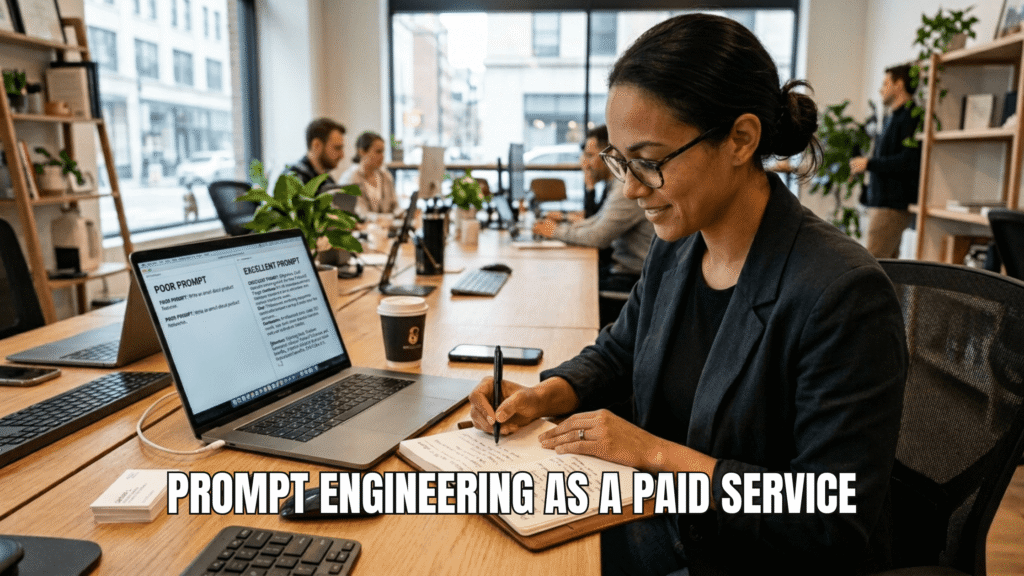
What Prompt Engineering Really Means
A prompt engineer is someone who figures out how to get AI systems to produce exactly the right output, consistently, at scale.
Companies and freelancers face the same issue. They use ChatGPT, get average results, and blame. The problem is in their AI instruction approach.Usually, the AI isn’t the problem. The instructions are.
A prompt engineer comes in and fixes the instructions.
That might sound simple. It isn’t. Good prompt engineering involves:
- Understanding what the AI model is optimised for (not all models behave the same)
- Structuring prompts to reduce ambiguity (AI fills gaps with averages, which is often wrong)
- Building prompt templates that non-technical teams can use without customising every time
- Testing prompt variations to find what consistently produces the best output
- Document the system, so it can be handed over, updated, or scaled easily.
Companies choose to pay, because their time is more expensive than hiring freelancers. A marketing manager wasting 2 hours a day getting bad AI output will happily pay $200 for a prompt system that fixes that problem in a week.
Who Is Buying Prompt Engineering Services Right Now
First, understand the complete process of how AI prompt engineering works, and then spend money on it.
Small business owners who started using AI tools and can’t get consistent output. They know what they want, they just can’t figure out how to make the AI understand it.
Marketing teams who need AI to produce on-brand copy, but every output sounds different. They need a template system and a style guide built into the prompt.
Freelancers who use AI to serve their own clients and want to work faster without quality dropping.
SaaS companies building products on top of GPT-4, Claude, or Gemini. They need system prompts that behave predictably at scale, not just sometimes.
E-commerce stores that want AI to generate product descriptions, but generic descriptions don’t convert. They need prompts calibrated to their brand voice and customer language.
None of these people are looking for a computer science degree. They’re looking for results. If you can deliver a prompt system that works, you’ll get paid.
Already on Fiverr? This skill can be offered directly as a gig. See how to set up services that clients actually buy in our guide:
How to Use ChatGPT to Earn Money on Fiverr in 2026
The Four Services You Can Offer as a Prompt Engineer
Prompt Audits
A client gives you their current prompts. You review them, identify what’s causing bad output, and deliver a report with improved versions.
This is the easiest entry point. You don’t need to build anything from scratch you just diagnose and fix.
Typical scope: 5–15 prompts
Delivery: PDF report + improved prompt versions
Price range: $30–$100
Custom Prompt Systems
A client wants to plug AI into a few key areas like content creation, support, and data summaries and they need a solid set of plug-and-play templates for their team to use.
You build a prompt library: 10–30 tested prompts organised by use case, with instructions
for how to use each one and what variations to try.
Typical scope: 2–4 weeks of testing and iteration
Delivery: Notion doc, PDF, or Google Sheet of prompts with usage notes
Price range: $80–$300
System Prompt Development for Businesses
A company is building an AI product, an internal tool, or a Custom GPT. They need a system prompt that defines the AI’s behaviour, tone, and constraints.
This is the most valuable part of prompt engineering because it’s the backbone of their product. If this breaks, everything breaks.
Typical scope: 1–2 weeks of building and testing
Delivery: Finalized system prompt + documentation + revision round
Price range: $150–$500+
AI Workflow Consulting
You map out a client’s entire workflow, identify where AI can save time, and build the prompt infrastructure to make it happen.
This isn’t just about writing prompts, it’s about understanding their business and designing a system around it. This is where hourly rates come in.
Typical scope: Ongoing or project-based
Rate: $20–$60/hour (reasonable from Pakistan to international clients)
What Skills You Need
You don’t need to code. You do need to think clearly.
Here’s the honest breakdown:
Skill
Python or coding
Deep AI knowledge
Writing skill
Logical thinking
Patience for testing
Understanding of the client’s
business
Do You Need It?
No
No
Yes
Yes
Yes
Yes
Notes
Helpful for API work, not required for service
selling
You need working knowledge, not a PhD
Good prompts are well-written instructions
You’re designing systems, not just writing
sentences
A prompt takes 15–40 variations to get right
Generic prompts produce generic output
If you’ve ever written an SOP, a brief, or step-by-step instructions for someone else, you already know how to do this. You’re just giving those instructions to AI instead.
How to You Learn Prompt Engineering (Without Paying for a Course)
Courses exist. Most of them are overpriced or teach theory instead of practice. The fastest way to learn is to do it.
Start with your own work. Take any task you currently do with AI and commit to making the prompt 5x better. Don’t accept the first output. Iterate until you have something that consistently produces what you want.
Learn the patterns that work. Strong prompts share common structures:
- Role assignment: “You are a senior copywriter with 10 years of experience in Pakistani e-commerce.”
- Task specification: “Write a 150-word product description for [product] that emphasizes [benefit 1] and [benefit 2].”
- Format instruction: “Use short paragraphs. No bullet points. End with a single CTA sentence.”
- Constraint setting: “Do not mention competitor brands. Avoid generic phrases like ‘high quality’ or ‘best in class.'”
- Tone anchor: “Sound like a knowledgeable friend, not a salesperson.”
Study what fails. When a prompt produces bad output, don’t just try again understand why it went wrong. Was the task unclear? Did you give conflicting instructions? Did you forget to specify format? The diagnosis is the lesson.
Read the model documentation. OpenAI, Anthropic (makers of Claude), and Google all publish guides on how their models respond to different prompt structures. These are free. They’re also almost never read by people selling prompt services. That gap is your advantage.
Want to understand the AI tools landscape better?
Read:
What Is Claude AI? How the Free Version Can Help Freelancers and Students in 2026
How to Find Your First Paying Client
This is where most people get stuck. The skill is one thing. The client is another.
Option 1: Fiverr
Create a gig. Title it something specific:
- I will write and optimize ChatGPT prompts for your business.
- I will build a custom prompt system for your content team.
- I will audit and fix your AI prompts for consistent results.
Your gig description should explain the problem, not the process. Buyers don’t care about how prompt engineering works. They care that their AI output is inconsistent and expensive to fix manually. Start there.
Option 2: LinkedIn and Upwork
These platforms work better once you have a case study or two. For now, Fiverr is faster.
Option 3: Local Pakistani businesses going digital
This is underestimated. The e-commerce boom in Pakistan. Daraz sellers, new brands launching on Instagram, physical stores going online — is creating demand for AI that produces on-brand content in Urdu and Pakistani English. Nobody is serving this market well yet.
Reach out directly. Message 20 Instagram business accounts in your city. Offer to build them a 5-prompt starter pack for free. Do it well. Ask for a testimonial. That testimonial is worth more than any course certificate.
Option 4: Bundle with your existing freelance service
If you’re already a content writer, social media manager, or virtual assistant, add prompt engineering as an upgrade. “I also optimize AI workflows for your team” is an easy upsell to existing clients who already trust you.
Need help landing better clients in general?
Our guide covers it:
How to Get High-Paying Clients as a Pakistani Freelancer in 2026
Pricing Your Prompt Engineering Services
New sellers usually under price because they don’t know what the market pays. Here’s a reference:
Service
Prompt audit (10 prompts)
Prompt pack (20–30 templates)
System prompt build
Monthly prompt maintenance
Beginner Price
$25–$40
$40–$70
$80–$150
$50–$100/month
6 Months In
$60–$100
$100–$200
$200–$500
$150–$300/month
Don’t compete on price with people who are already established. Compete on specificity. “I build AI prompts for Pakistani businesses selling on Daraz” beats “I write AI prompts” in every search because there’s less competition and the buyer immediately knows you understand their context.
How to Build a Portfolio With No Previous Clients
You need samples before clients trust you. Build them yourself.
Project ideas you can add to your portfolio:
- Pick a local business type, a biryani restaurant, a property agent, a clothing brand. Build a complete 10-prompt content system for them. Showcase before/after outputs.
- Take a badly performing public Fiverr GPT gig and rewrite the system prompt. Show the comparison.
- Write a case study: “I took this vague prompt, iterated 12 times, and this is why version 12 outperforms version 1.” That kind of clear, analytical writing shows clients you truly understand the work.
Upload your portfolio to a free Notion page or a simple Google Doc. Link it from your Fiverr profile and any proposals you write.
The Long Game: Why This Skill Compounds
Unlike other freelancing skills. Prompt engineering has its own approach. It’s help freelancing to react differently.
Those thinking transfers. The person who understands how to get consistent output from a language model can:
- Build better AI products (see our guide on Selling Custom GPTs and AI-Powered Products)
- Command higher rates as an AI consultant
- Over time, shift into AI strategy positions with remote companies offering dollar salaries to Pakistani professionals.
The entry point is writing better instructions for a chatbot. The exit point, a few years in, is a completely different income bracket.
Most people won’t do the work to get there. The ones who do will be very glad they started in 2026.
A Realistic 30-Day Plan
Week 1: Learn by doing. Take 5 tasks you already use AI for. Build the best possible prompt for each. Document your process.
Week 2: Build a portfolio piece. Pick a business type you understand. Build a full prompt system for it. Write up the results.
Week 3: Set up your Fiverr gig. Write the description, package your services, publish. Apply to 5 relevant jobs on Upwork.
Week 4: Reach out to 10 local businesses directly. Offer a free prompt review. Do it well. Collect a testimonial.
By day 30, you have a gig live, a portfolio sample, and your first few conversations with potential clients. That’s all, most people who bookmarked this article will ever get.
The Bottom Line
Prompt engineering isn’t magic. It’s just clear thinking. The people who are making money from it are not a technical guru. Making money doesn’t always mean being more skilled; it often means being more disciplined. Success comes from testing, improving, and delivering what truly works.
The AI tools are already on your computer. The buyers are already on Fiverr, LinkedIn, and in your city. The only missing piece is the decision to take it seriously.
Start this weekend. Build one thing. Show one person. See what happens.
2 Responses