Two years ago, dropshipping from Pakistan meant hours of manual work.
You scrolled AliExpress for winning products by guessing. You wrote product descriptions yourself, badly. You hired a designer for ad creatives and waited three days for a reply. Then you sat there hoping something would sell.
That version of dropshipping is dying.
The people building profitable stores in 2026 are doing the same job in a fraction of the time, because AI is now doing the product research, the copywriting, the customer support, and even the ad creatives. You’re the operator. The AI is your unpaid team.
This guide breaks down exactly how someone sitting in Pakistan can start an AI assisted dropshipping store and sell to customers in the US, UK, Canada, or the Gulf, without needing a design degree or a marketing background.
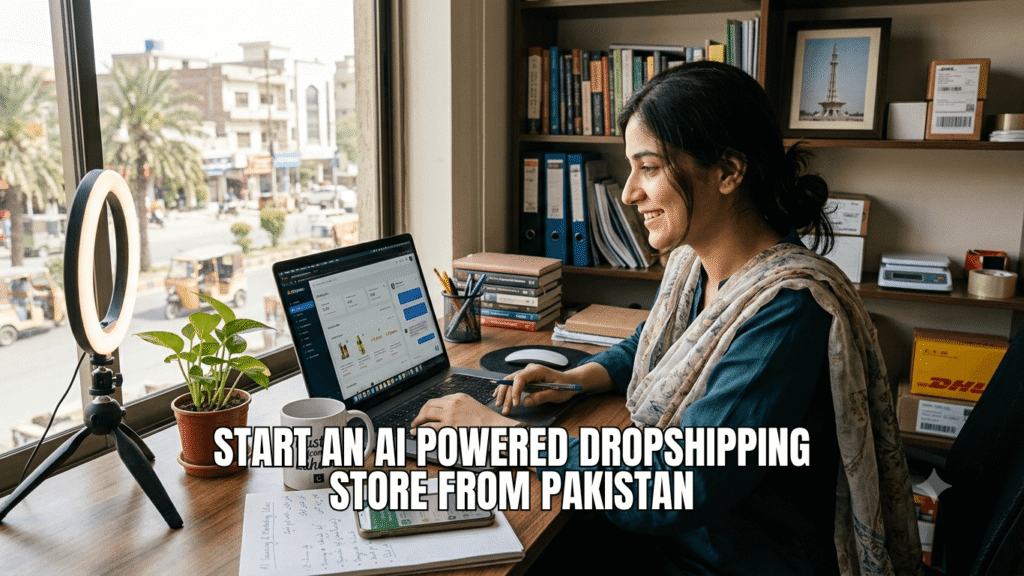
Why Dropshipping Still Works in 2026 (With a Catch)
Dropshipping isn’t dead. Lazy dropshipping is dead.
Selling random trending products with a copy pasted description and hoping Facebook ads carry you is what killed most stores in the past few years. What still works is picking a specific niche, building a store that looks legitimate, and using AI to move faster than everyone still doing things manually.
The advantage for someone in Pakistan is simple. Your costs are in PKR. Your revenue, if you’re targeting Western customers, comes in USD or GBP. That exchange rate alone makes even a modest store worth running seriously.
The AI Tools You Actually Need
You don’t need ten different subscriptions. Here’s the real stack people are using.
Tool and What It Does
ChatGPT or Claude — Writes product descriptions, ad copy, email sequences Canva AI (Magic Design) — Creates product images, ad creatives, and store banners CapCut AI — Edits AI generated UGC style video ads for TikTok and Facebook AutoDS or Zendrop — Finds trending products and automates order fulfillment Tidio or Gorgias — AI chatbot for customer support on your store ChatGPT Vision or Perplexity — Researches competitor stores and market trends
Free Plan Available
Yes, limited daily use Yes, basic templates free Yes, watermark free tier Free trial, then paid Free tier for small stores Yes
Most beginners can run their first month entirely on free tiers before spending a single rupee on paid tools.
Step 1: Pick a Niche With AI, Not a Gut Feeling
Stop scrolling TikTok for “trending products” and copying whatever you see. Use AI to actually research.
Ask ChatGPT or Claude something specific like: “List 15 physical product niches with rising search interest in the US and Canada, that have low competition on Shopify, and can be sourced from AliExpress or CJdropshipping.”
Then cross check the suggestions using Google Trends and the AliExpress dropshipping center, which shows order volume for similar products. AI gives you the direction, the data confirms it.
Focus on a specific problem, not a broad category. “Pet grooming tools for anxious dogs” beats “pet products” every time. Specific niches convert better and cost less to advertise.
Step 2: Build Your Store Without Hiring a Designer
Shopify remains the standard, but the store building process itself has changed.
Use Canva’s AI tools to design your logo, product mockups, and homepage banners in under an hour. There are also Shopify apps like Shopify Magic that generate product descriptions directly inside your admin panel using the product title and a few keywords.
For the actual product descriptions, this prompt works well with ChatGPT or Claude: “Write a product description for [product name] targeting [audience], focused on the main problem it solves, in a friendly and confident tone, under 150 words, with three bullet point benefits.”
Don’t publish the first draft. Read it out loud once. If it sounds like a robot wrote it, ask the AI to rewrite it “more casually, like a friend recommending it.”
Step 3: Set Up AI Customer Support From Day One
This is the part most Pakistani dropshippers skip, and it’s the reason a lot of stores get bad reviews.
Tools like Tidio come with an AI chatbot that can answer “where’s my order,” “what’s your return policy,” and “does this fit size medium” automatically, twenty four hours a day. Since your customers are usually in a different time zone, this alone can save your store’s reputation while you’re asleep.
Set it up once with your FAQ, shipping times, and return policy. It handles the rest.
Step 4: Use AI for Ad Creatives, Not Just Product Photos
Paid ads are still how most dropshipping stores get their first sales. The creative is what makes or breaks the ad, not the targeting.
CapCut’s AI tools let you generate UGC style video ads using AI avatars or stock footage, add auto captions, and match trending audio, all without filming anything yourself. Combine this with a short AI written script (again using ChatGPT or Claude) that follows a simple hook, problem, solution, call to action structure.
Run these on TikTok Ads or Meta Ads with a small daily budget, around $5 to $10, and let the platform’s algorithm find your buyers. Kill anything that doesn’t get engagement within 48 hours.
What Niches Are Actually Working Right Now
Niche and Why It Works
Pet health and anxiety products — Emotional buyers, low return rates Home organization and small space living — Rising interest from apartment renters in the West Posture and ergonomic desk accessories — Remote work boom continues Skincare tools (not skincare products) — Avoids strict ad policies around cosmetics claims Car interior accessories — Repeat buyers, easy to bundle
Avoid anything requiring FDA approval, health claims, or electronics with battery shipping restrictions. These get your ad accounts banned fast, and rebuilding trust with Meta or TikTok takes weeks.
Realistic Timeline and Earnings
Nobody makes $10,000 in their first month. Here’s what’s actually realistic for someone starting from zero.
Stage and Timeline and Monthly Result
Store setup and product research — Week 1 to 2 — PKR 0, investment phase First ads launched, testing 2 to 3 products — Week 3 to 4 — Likely a loss, this is normal First profitable product found — Month 2 — $100 to $300 profit Scaling the winning product — Month 3 to 4 — $500 to $1,200 profit Adding a second product line — Month 5 to 6 — $1,500 to $3,000 profit
These numbers assume consistent daily work and a starting ad budget of around $150 to $300 that you’re prepared to lose while testing. Dropshipping without a testing budget rarely works.
Getting Paid and Managing Money From Pakistan
This is where a lot of Pakistani dropshippers get stuck, so plan for it before you launch.
- Payoneer: Connects with Shopify Payments in supported regions and works for receiving PayPal transfers indirectly through a linked account.
- Wise: Useful for holding USD and GBP balances and paying for tools like Shopify, CapCut Pro, or ad accounts without conversion losses.
- Stripe (via a partner or business setup): Not directly available to individuals in Pakistan, but some freelancers use a trusted partner abroad or register through supported programs. Research this carefully before committing.
- JazzCash or Easypaisa: Fine for paying local expenses like your VPS or a Fiverr freelancer helping with design work.
Keep your ad spend and product costs in a separate Wise account from day one. Mixing personal and business money is the fastest way to lose track of whether you’re actually profitable.
Common Mistakes to Avoid
Copying a store exactly. AI makes it easy to copy someone else’s store structure and descriptions in minutes. Customers notice when three stores sell the same generic product with identical descriptions. Use AI to make your version genuinely better, not identical.
Ignoring the chatbot setup. A store with no way to answer customer questions instantly loses sales it never even sees, since most people won’t email and wait two days for a reply.
Testing too many products at once. Pick two or three products, give each one a real ad budget, and let the data decide. Testing ten products with $5 each tells you nothing.
Skipping the legal basics. Add a proper refund policy, privacy policy, and terms of service page. AI can draft these for you in minutes using ChatGPT, but a store without them looks unprofessional and can get flagged by ad platforms.
Quick Start Checklist
- Pick a niche using AI research plus Google Trends validation, not a guess
- Set up a Shopify store and generate your first product descriptions using ChatGPT or Claude
- Design your store banners and logo using Canva AI
- Install an AI chatbot like Tidio and set up your FAQ responses
- Create your first three video ad creatives using CapCut AI
- Open a Wise account to hold ad spend money separately from personal funds
- Set a testing budget of at least $150 before launching, and commit to two to three products only
AI won’t build a profitable store by itself. It removes the excuses that used to stop people from starting, the missing design skills, the writer’s block, the twenty four hour support problem. What’s left is testing, patience, and actually showing up every day until one product works.